

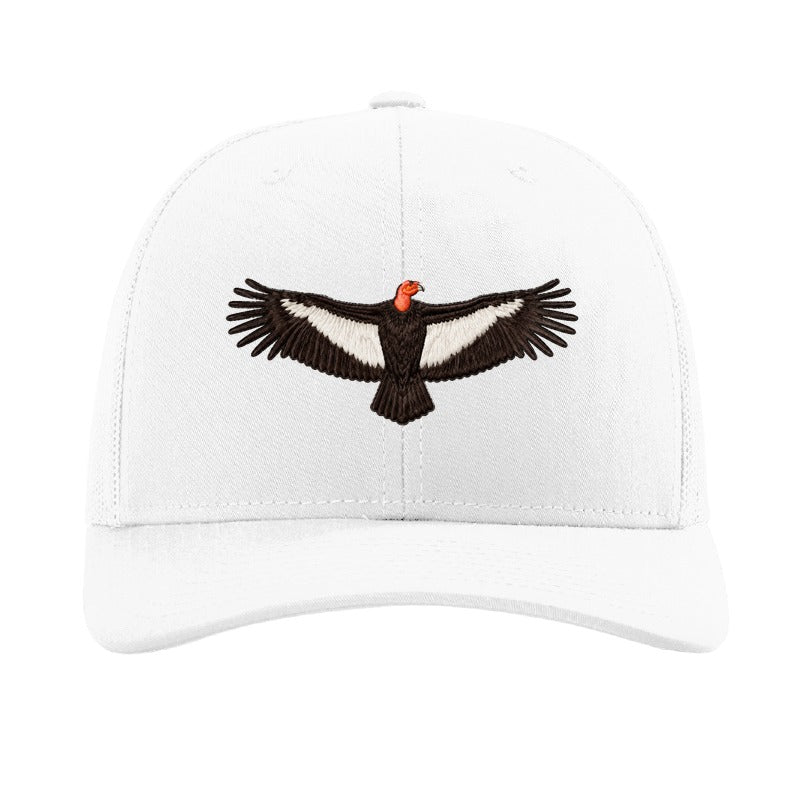
Two stories, and what links them is that both reward the same habit: looking up, and being patient about it. One is a bird that was down to twenty-two individuals inside living memory and is now past six hundred. The other is a stream of debris that has been crossing Earth's orbit for thousands of years and puts on its best show in the weeks around Halloween. Both are now hats.
Vermilion Cliffs, Arizona: from 22 birds to more than 600
On 15 October the release programme at Vermilion Cliffs, the red sandstone escarpment in northern Arizona near the Utah line, marked thirty years of putting California condors back into the sky. The anniversary is the occasion, but the arithmetic is the story. In the late 1980s the entire world population of California condors was twenty-two birds. Every one of them was taken into captivity, because leaving them out was a slower way of losing them.
Today there are more than six hundred, and 392 of those are flying free across four release sites. That is not a rounding error on a conservation programme; that is a species pulled back from the edge one bird at a time over four decades. Four juveniles took their first free flight off those cliffs on 26 September.

A condor is a gift of a patch subject: nine and a half feet of wingspan held flat and level, the outer primaries splayed into separate fingers, a small bare orange head pushed forward on a thick neck. The silhouette alone tells you it is not a hawk and not an eagle. The Embroidered Condor Trucker Hat carries it as a full-colour embroidered patch die-cut to the bird's own outline, wings fully spread at roughly four inches across, with the white underwing panels that birders use to pick a condor out at a distance stitched in.
Shop the Embroidered Condor Trucker Hat →
The Taurids: the slow, bright ones
The Southern Taurids hit their first peak on 14 October and run until 20 November. The Northern branch opens on 20 October and carries on into December. Because the two overlap across late October and early November, they have picked up the nickname the Halloween fireballs, and the nickname is earned rather than marketing.
What makes the Taurids worth staying out for is not the rate. Each branch manages about five meteors an hour, maybe ten for the two together on a clear moonless night, which is feeble next to a good Perseid show. What they have instead is size and slowness. Taurid meteors come in at roughly seventeen miles a second, where the Orionids arrive at more than twice that, and the stream carries larger grains. A big slow particle survives longer in the atmosphere and burns brighter for it, which is why the Taurids throw the occasional fireball that lights the ground under you. The debris comes off Comet 2P/Encke, a three-mile-wide comet whose 3.25-year loop is the shortest known cometary orbit.

Worth being honest about the year: this is not one of the enhanced swarms. Those fell in 2008, 2015 and 2022, and the next is forecast for 2032. So the draw in 2026 is character rather than count. The Taurid Fireballs 2026 Trucker Hat puts one of them across a wide, low banner patch in soft enamel on brushed nickel: a single fireball crossing a midnight-blue field, its trail running orange through amber to the green-white that bright Taurids actually show, with the lettering left in bare raised metal.
Shop the Taurid Fireballs 2026 Trucker Hat →
Both are on the shelf
Both hats come in six colorways on the Richardson 112 plus the Infinity Charlie ponytail cap, cut and finished to order: the Embroidered Condor Trucker Hat for the bird that came back, and the Taurid Fireballs 2026 Trucker Hat for the meteors that run through Halloween. The rest of the daily drops live in the Hot Off the Press collection.










Share:
Cleveland's Orangutans Move Into a $60 Million House on 22 October