
Two findings landed within a few days of each other this month, and they have almost nothing in common except the shape of the story. In both cases, somebody looked closely at a place that had already been looked at, and found that the thing everyone assumed was one thing was actually another. Under Jezero Crater, water that was not just water. In the Kerguelen Islands, a penguin that was not just a penguin.
That is the kind of thing worth a patch — not the discovery of somewhere new, but the re-reading of somewhere familiar. Both designs are below.
Jezero Crater: the water was hot
NASA picked Jezero as a landing site because it wore its history on its face. From orbit you can see a basin that clearly once held a lake, and a river delta fanning into it from the western rim. That was the whole pitch: go where the water was.
What the Perseverance rover turned up this September, announced on the 24th, complicates that pleasantly. Minerals in the crater floor record hot groundwater circulating underneath Jezero — a heated system moving through rock, not simply a lake sitting on top of it. Warm water moving through stone is, on Earth, one of the more reliable places to go looking for life. It also means the plumbing under that crater was busier and more tangled than the orbital photographs suggested. "Mars constantly throws surprises at you," one of the mission scientists said, which is the sort of line you only earn after a decade of being surprised.
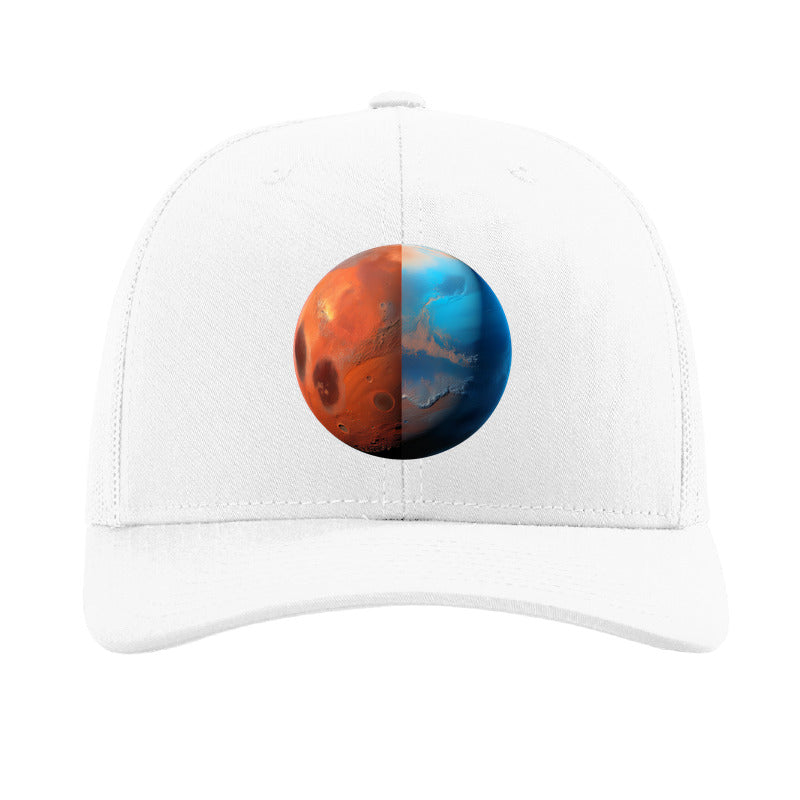
The patch holds both readings of the planet in one disc: the dry, cratered Mars we photograph today on the left, the wet one those minerals imply on the right, split straight down the middle. It is UV-printed in full colour on brushed aluminum and cut as a round disc, about two and a half inches across.

The Aluminum Mars Trucker Hat comes in five Richardson 112 colourways plus a ponytail-opening cap in Dusty Rose.
Shop the Aluminum Mars Trucker Hat →
Kerguelen: four penguins where there was one
The Kerguelen Islands sit roughly two thousand miles from the nearest inhabited land, in the sub-Antarctic Indian Ocean, which goes some way to explaining how this went unnoticed for a century. On 21 September a team led from Chile and UC Berkeley published that the gentoo penguin — one bird, as far as anyone had recorded — is in fact four distinct species. One of them, the southeastern gentoo of Kerguelen, had never been named. It is the first new penguin species named in more than a hundred years.
The same paper carries the part that stings: its climate models give the islands this bird lives on until roughly 2050 before they stop suiting it, with not much nearby to move to. A species gets a name and a deadline in the same publication. That makes the naming feel less like a discovery and more like an introduction you would want to act on.
The patch is a king penguin — another of Kerguelen's residents, and the bird that stands best at two and a half inches. It is a twill patch in SolidCore Embroidery™, contour cut to the penguin's own outline with no border around it, so it reads as a bird on the cap rather than a badge. SolidCore looks and feels like stitched work, and holds colour and fine detail that thread cannot.

The Embroidered Penguin Trucker Hat runs the same six colourways.
Shop the Embroidered Penguin Trucker Hat →
Both, then
A planet re-read from its minerals and a bird re-read from its genes, four days apart. If you want them on your head: the Aluminum Mars Trucker Hat and the Embroidered Penguin Trucker Hat, both made in Avon Lake, Ohio, just west of Cleveland.









Share:
Boca Chica, Texas: the Biggest Rocket Ever Built Goes for Orbit
Avon Lake's Harvest Moon Came Up Wearing Rings of Colour